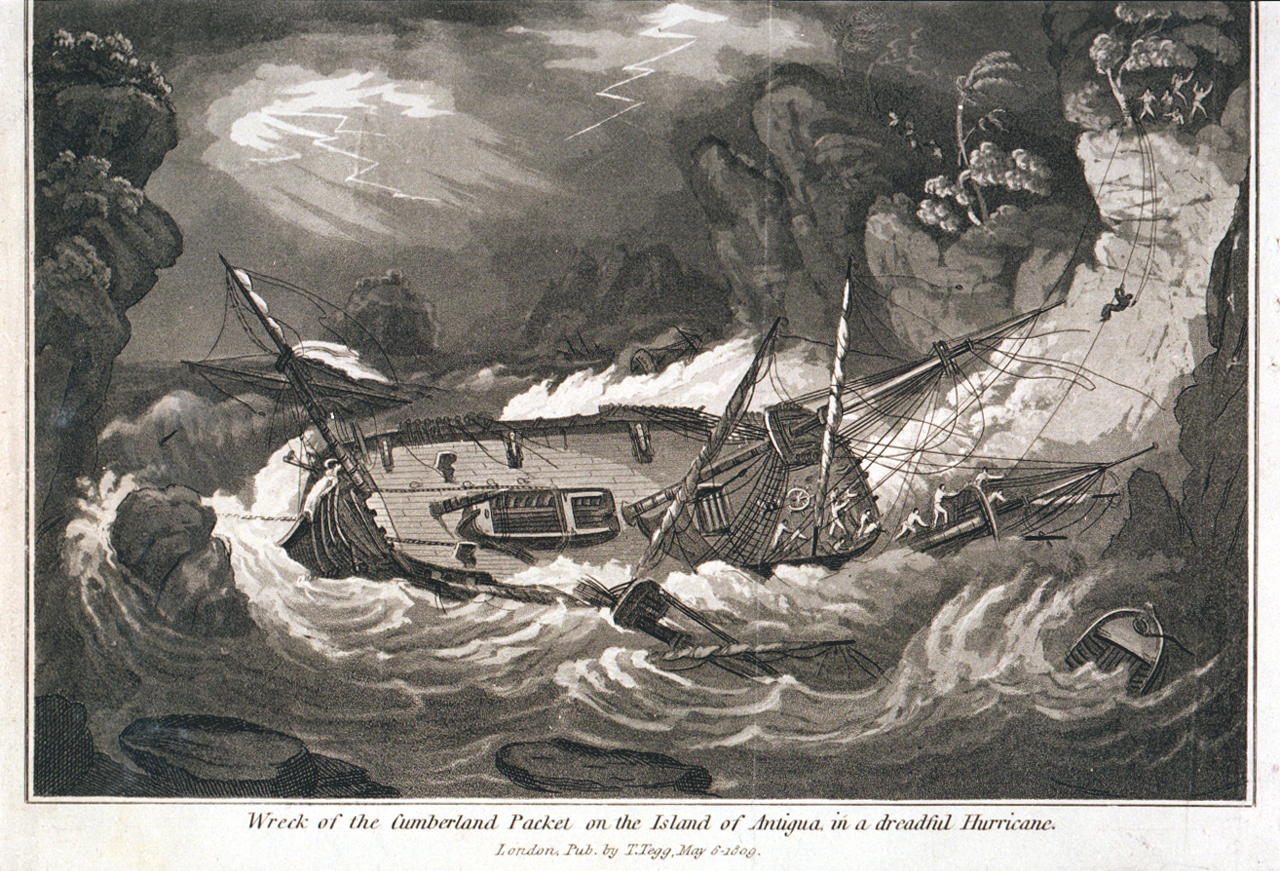
In 1830, the British military dispatched Major-General Sir William Reid, a highly-decorated Scottish military engineer, to Barbados. His mission was to survey and repair government buildings destroyed by a large storm that had killed 1,500 people.
Reid noticed peculiar patterns in the flattened buildings and trees. His interest in this led to a collaboration with American meteorologist William C. Redfield, who theorized that a similar storm in Connecticut was a massive, counterclockwise whirlwind. In an effort to put hard data to this theory, Reid studied the log books and reports of British vessels that had encountered storms out of the Carribean.
In 1838, Reid published An Attempt to Develop the Law of Storms by Means of Fact. The book was an international success in which Sir William proved that hurricanes in the Northern Hemisphere turn counterclockwise, and unknowingly provided rich context for genealogists studying immigrants nearly two hundred years later.
In a short history written by one of Michael Eifert’s grandchildren, her grandfather’s journey across the Atlantic on the Wanstead was described as, “Quite an ordeal,” with some days spent barely moving in the doldrums of summer, and other days of high winds.
Sir William Reid’s book provides some color to those events. In his attempt to understand the counterclockwise direction of winds, Sir William studied the reports of incoming vessels to understand when they had encountered storms. In New York, on Sept. 8, 1837, it is written:
The barque Wanstead, arrived here from London, experienced on the 23rd August, in lat. 43° 34′, long. 54° 20′, a severe gale of wind; lost boat, stove bulwarks, and washed seven men and the captain overboard, and succeeded in getting them on board again.
An Attempt to develop the law of storms by means of facts arranged according to place and time, p. 82
What an experience that must have been. The Wanstead was a three-masted barque. The Eiferts and a hundred others were huddled together in the cramped steerage space. The hatches had been battened down, so none could go above deck. In the darkness they heard rope and a lifeboat being torn from the ship, and the cries of men being swept overboard by the gale. The very walls of the ship were being broken by the storm.
Miraculously, the crew was able to get all seven men back on board and limp onward to New York. They had encountered one of several hurricanes that had rolled up from the Caribbean and out into the Atlantic in 1837.
Thanks to Sir William Reid, similar details can be learned about many ships. A searchable PDF of the book can be found at this link. If you know the name of your ancestors’ ship, you might find an account of it here!
Here are a few of the stories found in the book. There are many more.
Ships in the hurricanes of 1837
US-connected vessels documented in William Reid’s An Attempt to Develop the Law of Storms (1838)
Wanstead Barque
On 23 August, in lat. 43° 34′, long. 54° 20′, the Wanstead was struck by a violent gale. The storm stove in her bulwarks, destroyed her boat, and — most dramatically — swept seven men and the captain overboard. All were recovered and brought back on board. She arrived safely at her US destination, the incident reported in the press on 8 September.
Calypso Ship
Struck on 15 August, the wind rising until masts bent like canes and the fore-scuttle was stove in. The ship capsized; the crew cut away all three masts at the deck to right her. Left dismasted and nearly without provisions — two-thirds of a puncheon of water, two bags of damaged bread — men remained at the pumps day and night, rationed to half a pint of water per day. Aided on 30 August by the brig Rupert, she limped into Wilmington on 2 September under jury-masts, greeted by townspeople whose houses had been unroofed by the same storm.
Sheridan (Russell) Packet ship
On 22 August, in lat. 39° 45′, long. 68° 33′, encountered a hurricane that stripped the fore and main-topsails clean from the yards, leaving nothing but the bolt-rope standing. Arrived New York six days later.
Harmonie Brig (Mecklenburg)
Driven ashore fifty miles south of the Capes on the night of 19 August. The captain came to town for assistance, reporting the vessel was tight and could be got off without much damage.
Hindley Turner —
Dismasted off Sandy Hook on 16 August and brought into New York. Her three lower masts were replaced without discharging cargo, and she was expected to proceed within a fortnight.
Columbia Steam-packet
Experienced a severe gale on 20 August shifting from east to northwest. Reported in the New York General Advertiser.
Powhatam Chase —
On 22 August, in lat. 40°, long. 67° 30′, encountered a tremendous hurricane veering from east-southeast to north, losing both top-gallant-masts.
Vincennes Brig
On 21 August, in lat. 35° 30′, long. 65° 40′, experienced a heavy gale from the south-southwest.
James Busick Schooner
Damaged in a severe gale on 14 August that continued with violence for thirty-six hours, forcing her to turn back to Norfolk.
Oglethorpe —
Experienced a violent gale from the northwest on 13 August. Latitude not recorded.
Deucalion American ship
Spoken by the Duke of Manchester on 21 August. The captain reported his ship — a fine vessel of 800 tons — had nearly gone down in the storm, though she survived.
Leave a Reply